His Eminence the Deputy Grand Mufti of Uganda, Sheikh Ali Waiswa,
The representative of the Chairperson of the Electoral Commission, Mr. Mucunguzi,
The representative of the Inspector General of Police,
The Representative of the Executive Director of the Uganda Communications Commission,
Representatives of the Political Parties, Civil Society, and the Media,
Staff of the Uganda Human Rights Commission,
Distinguished Guests, Ladies and Gentlemen,
Good morning.
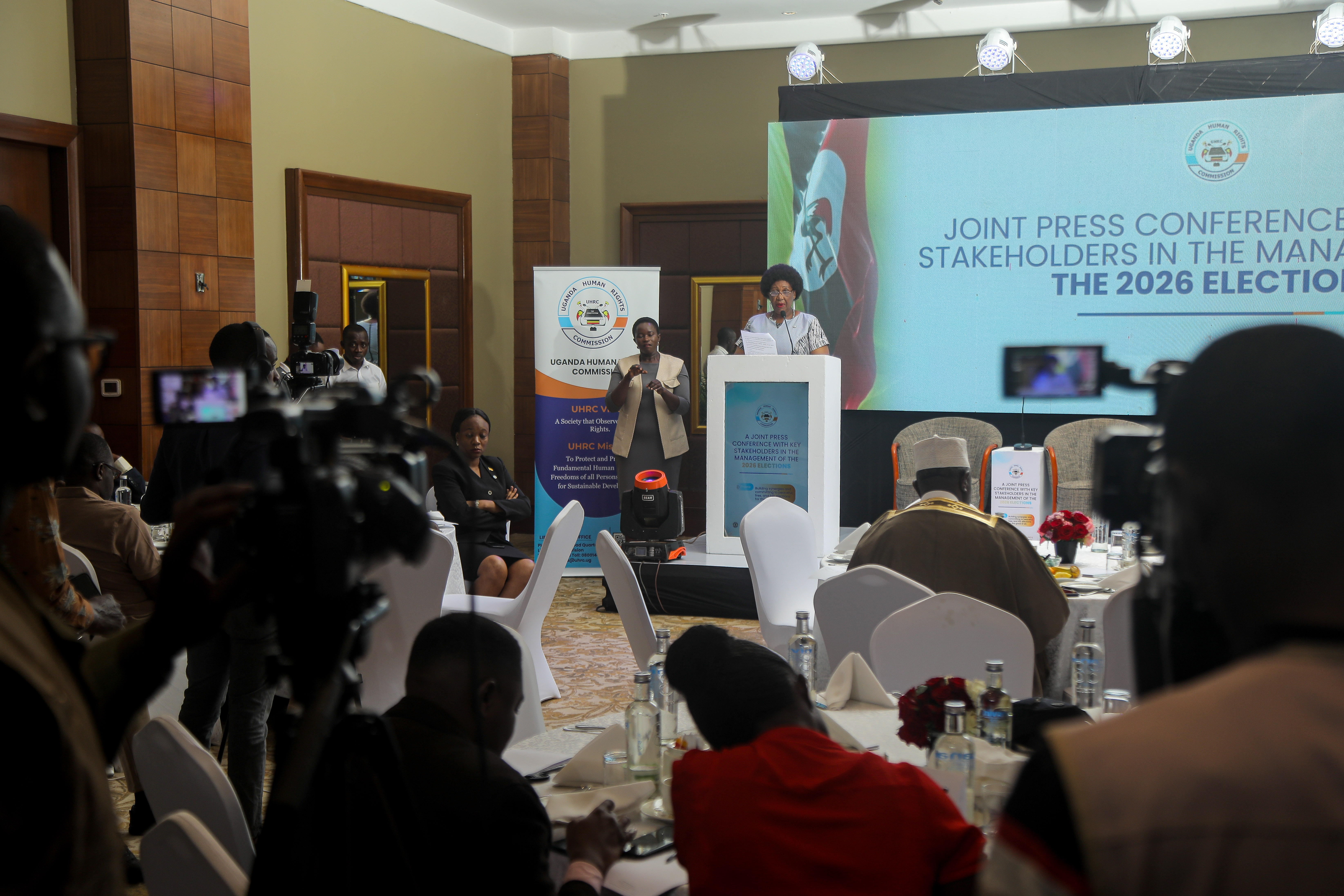
It is a privilege to address you today alongside key national institutions with whom we share a strong and collective responsibility for safeguarding Uganda’s democratic processes. This press briefing is organised in partnership with the Electoral Commission, the Uganda Police Force, Uganda Communications Commission, the Inter-Religious Council of Uganda and the National Initiative for Civic Education in Uganda (NICE-UG). I thank these institutions for their unwavering collaboration, professionalism, and resolve as we enter the final stretch of the 2026 electoral cycle.
We have travelled a long road since the Electoral Commission launched the electoral roadmap eighteen (18) months ago. Today, with only six weeks to Election Day on 15th January 2026, we gather with one purpose: to affirm our national commitment to a Uganda where citizens exercise choice freely, where competing ideas are expressed with civility and mutual respect, and where elections strengthen unity rather than rupture it. A free, fair, and peaceful election is not merely a political aspiration; it is a constitutional command under Article 59.
The State must at all times guarantee that every eligible Ugandan can register and vote without hindrance, including persons with disabilities and those from vulnerable and marginalized communities. Even children, though they do not vote, must be protected from the indirect harms of electoral tension and disorder.
Once again, let me in a special way, welcome the representatives of the Chairperson of the Electoral Commission, and the Inspector General of Police. I commend the EC Chairperson for guiding the country through a clear, predictable and inclusive electoral roadmap over the past 18 months, and I recognize the IGP for his steadfast commitment to human rights and professional policing.
I also acknowledge the Uganda Communications Commission for its crucial role in ensuring an orderly and responsible communications environment, especially in an era when information spreads rapidly and misinformation spreads even faster. In the same way, the Inter-Religious Council of Uganda and NICE-UG have consistently preached peaceful participation and tolerance, and we deeply value their leadership at this delicate moment. We also pay tribute to the Grand Mufti of Uganda, Sheikh Shaban Mubajje for his consistent message of peace, unity, inclusion, love and tolerance.
Ladies and gentlemen,
As we monitor the pre-election environment, the Commission has observed several emerging trends that I must say present risks to peace, security, and human rights. Allow me to raise a few of them frankly and clearly.
We have noted the rise of youth groups acting as vigilantes and political foot soldiers, particularly in the central region. These groups are unlawful, dangerous, and incompatible with a democratic process.
Election security remains the constitutional mandate of the Uganda Police Force alone, and we urge that these formations are disbanded immediately wherever they exist.
Ladies and gentlemen,
We are also witnessing worrying expressions of identity-based politics. In Bunyoro for instance, the Abafuruki narrative is resurfacing, and in Kigezi, religious-based mobilisation between Catholics and Protestants has re-emerged in some areas. Identity politics corrodes the foundations of equality and non-discrimination and threatens to divide communities that have lived together for generations. Elections must never become platforms that inflame tribal or religious sentiment.
In addition,
We are increasingly concerned about the rise of misinformation. In the central region and other parts of the country, falsehoods and biased reporting are being used to stoke anxiety. It is troubling that some mainstream media houses have recently swung into action to discredit the electoral process through narratives that are false, exaggerated, or selectively framed.
Notably, the claims of police brutality against some candidates circulating in selected outlets have not been corroborated by facts, yet they are being amplified recklessly. Such conduct undermines public confidence and harms the integrity of the electoral process.
We therefore call upon the media to uphold professionalism, responsibility, objectivity, accuracy, and patriotism. The media is the bridge between institutions and citizens. That bridge must not be used to breed fear or distort reality. In an age of artificial intelligence and largely unregulated digital platforms, the obligation to verify information before publishing it is not just a journalistic requirement; it is a national duty. We urge every Ugandan using social media to exercise restraint, skepticism, and responsibility. Information can build a nation or break it.
Stakeholders here present,
We are also concerned about gender-related constraints on political participation. Reports from multiple regions indicate that some women feel compelled to seek permission from their husbands before choosing which candidate to support. This practice violates women’s constitutional rights and has, in many cases, contributed to spikes in sexual and gender-based violence. It must be condemned unequivocally.
Ladies and Gentlemen,
Uganda needs a peaceful electoral season built on respect, restraint, and responsibility. This is why today’s gathering of key institutions is both symbolic and substantive. We stand together to reaffirm our commitment to upholding the rule of law, safeguarding rights, and ensuring a credible electoral process.
To political parties and candidates,
Your leadership is critical. The Commission commends those who have demonstrated restraint and maturity. Continue to put Uganda first.
Campaign with dignity, respect your opponents, and honour the rights of your supporters and non-supporters alike. Uganda is bigger than any individual, movement, or campaign message.
To the electorate,
These elections are about your voice and your future. Participate peacefully. Reject violence. Respect opinions different from your own. Democracy thrives on diversity of thought, not uniformity of belief.
To the security agencies,
Your role is indispensable. Maintain law and order firmly, professionally, and within the confines of human rights principles. The use of force must always be lawful, proportionate, and a last resort. The country is counting on your discipline.
As the Human Rights Commission,
We have been active throughout the country holding preventive dialogues with political leaders, cultural institutions, religious leaders, security personnel, and communities. Our campaigns monitoring teams are on the ground daily, calling out acts of violence and violations. On Election Day, UHRC will deploy observers and will issue its assessment publicly. We have established a 24-hour hotline for citizens to report human rights concerns. We will continue to provide civic education and engage stakeholders to keep our democracy stable, peaceful, and inclusive.
Dear friends,
Our message is simple, peace is everyone’s responsibility. Uganda must prove that disagreement does not mean division and that competition need not lead to conflict.
The credibility of the 2026 polls will depend on respect for human rights, tolerance, and adherence to the rule of law. Elections are strongest when citizens feel safe and empowered to express their will freely.
Let us work together as institutions, political parties, civil society, the media, and citizens to ensure that the 2026 elections become a celebration of democracy, not a contest of hostility. Let us uphold human rights, the rule of law, and the dignity of each and every Ugandan without discrimination on any ground.
For God and My Country.
